


If this were a movie, Vitamin D would be the unassuming supporting character who turns out to be the mastermind behind the whole plot.
Most people think of it as the sunshine vitamin - a feel-good bonus you get from jogging in the park. But in reality it is more like a hormone. A powerful one. And it does not just help your bones. It helps everything.
Heart health. Immune function. Brain protection. Hormone regulation. Even cancer risk. Vitamin D is the molecular equivalent of a Swiss Army knife - except if you are low on it, you are not just missing a blade or two. You are missing the handle.
And here is the kicker: most people are chronically deficient.

What Vitamin D Actually Is #
Vitamin D3 (cholecalciferol) is the form your skin produces when exposed to sunlight. It is technically not a vitamin in the classical sense because your body can make it - assuming you live naked on a beach and never wear sunscreen. Since that is not exactly the modern lifestyle, supplementation becomes less of a wellness hack and more of a survival strategy.
Once produced or ingested, D3 is converted by your liver and kidneys into its active form, calcitriol. That active form binds to receptors all over your body - affecting hundreds of genes and cellular functions. It is involved in everything from immune signaling to mood regulation to calcium transport.
The K2 Connection - Not Optional #
This is where most people get it wrong.
Imagine Vitamin D as the delivery truck that loads up your blood with calcium. Great. But now imagine that truck dropping its cargo in all the wrong places - your arteries, your kidneys, your joints. That is exactly what can happen when K2 is not around to direct the flow.
Vitamin K2 activates proteins called osteocalcin and matrix GLA protein - molecular traffic cops that tell calcium where to go (your bones) and where not to go (your arteries). Without K2, high-dose Vitamin D can become counterproductive. With it, it is a precision tool.
D3 and K2 are not optional partners. They belong together. Always.
What the Research Actually Says #
Studies have linked low Vitamin D levels to a significantly higher risk of cardiovascular disease, osteoporosis, autoimmune conditions, depression, diabetes, certain cancers, and all-cause mortality.
High-dose D3 supplementation - especially paired with K2 - has shown promise in improving insulin sensitivity, lowering blood pressure, reducing inflammation markers, and modulating immune function. During the COVID-19 pandemic, D3 made headlines for its role in immune resilience. That was not hype. That was biology.
K2 independently improves bone mineral density, reduces arterial calcification, and may support mitochondrial health and insulin sensitivity - two key markers of metabolic aging.
Both nutrients are inexpensive and remarkably safe at the right doses. There are very few supplements where the evidence-to-cost ratio is this strong.
How Much You Actually Need #
Vitamin D dosing is not one-size-fits-all. Blood testing is ideal - you want your 25-hydroxyvitamin D level between 40 and 60 ng/mL for optimal function. Most people testing their levels for the first time discover they are sitting at 20-30 ng/mL - technically deficient.
General dosing guidelines:
- Adults: 2,000-5,000 IU D3 daily + 100-200mcg K2 MK-7
- Older adults or those with limited sun exposure: 4,000-10,000 IU D3 (with blood testing)
- Teenagers: 1,000-2,000 IU D3 + 50-100mcg K2
- Children under 12: only with pediatrician supervision
The K2 form matters. Choose MK-7 (menaquinone-7) - ideally from fermented natural sources. Not MK-4, which is more short-lived in the body and requires frequent dosing to maintain levels.
Forms and Bioavailability #
D3 over D2. Always.
Vitamin D2 (ergocalciferol) is cheaper and found in many fortified foods, but it is poorly converted and significantly less effective. Always choose D3 - preferably as a softgel or oil-based drop, not a dry tablet.
No fat, no absorption. Vitamin D is fat-soluble. Taking it with a dry breakfast or black coffee means you are absorbing a fraction of what is on the label. Take it with a meal containing fat.
Timing and Stacking #
Morning or midday is best. High doses taken right before bed may interfere with melatonin signaling in sensitive individuals.
Vitamin D3 pairs particularly well with:
- Magnesium - D3 increases your body’s demand for magnesium. People who experience side effects from D3 supplementation are often simply low in magnesium. This combination is especially important.
- Omega-3s - overlapping anti-inflammatory pathways, stronger combined effect
- CoQ10 - enhanced cellular energy and mitochondrial support
- Vitamin A - works synergistically in proper ratio
One thing to avoid: combining high-dose D3 with megadose calcium supplements unless you have a specific clinical reason and medical supervision.
The Myth Worth Killing #
You cannot get enough Vitamin D from food. Not unless you are eating sardines and cod liver oil at every meal. Fortified foods contain trivial amounts. Sun exposure in northern latitudes, especially in winter, produces almost nothing.
If you live anywhere above 35 degrees latitude and work indoors, supplementation is not optional. It is basic maintenance.
Safety and Side Effects #
Unless you are megadosing into tens of thousands of IU daily without supervision, Vitamin D3 is remarkably safe. Toxicity is rare and usually only appears at sustained doses above 40,000 IU daily over months - not at the 2,000-5,000 IU range most people use.
The most common issue: people taking D3 without enough magnesium and experiencing fatigue or muscle cramps as a result. The solution is not less D3 - it is adding magnesium.
The Bottom Line #
Vitamin D3 + K2 is the single best value supplement combination in the longevity stack. Broad systemic effects, decades of research, extremely low cost, and a safety profile that makes most other supplements look risky by comparison.
If you are not taking it or not taking it correctly - with fat, with K2, at an adequate dose - you are leaving one of the clearest wins in preventive health on the table.
Anti-Aging Factor: 8.5 out of 10. Essential foundation for any serious longevity protocol.
Want to Go Deeper? #
The complete protocol - dosing, stacking, biomarker tracking and a 30-day starter plan: Don’t Buy NMN Until You Read This - $47
The full longevity picture - supplements, nutrition and science-based habits:
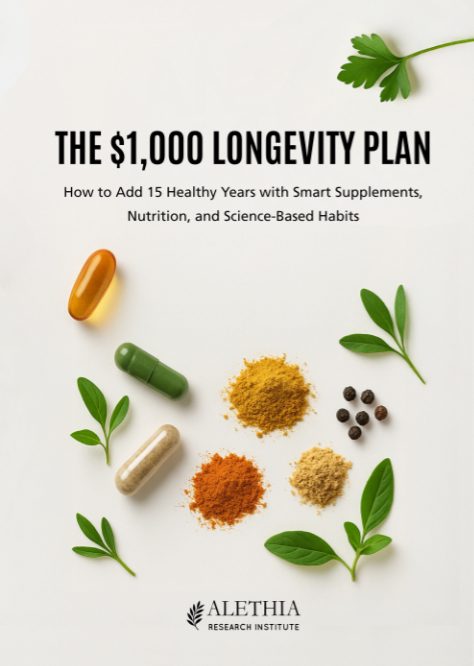
The $1,000 Longevity Plan on Amazon
Both by Alethia Research Institute. No pharma ties. No fluff.